

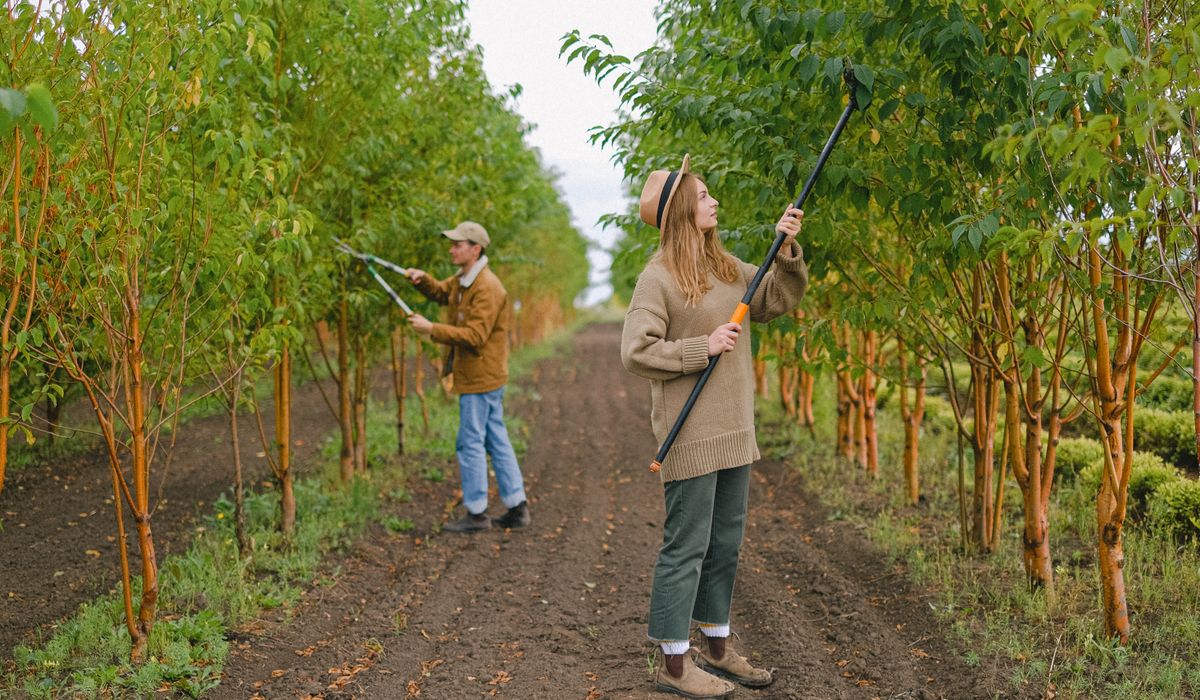
Protecting Trees from Deer and Rabbit Damage
Why young trees need protection
A newly planted whip is a tempting meal. Its bark is thin and sweet, its buds sit within easy reach, and it has no reserves to fall back on if the leader is nibbled away. In a garden or a young woodland, one hard winter can set a planting scheme back by years, turning a planned stand of oaks and limes into a row of stunted, multi-stemmed shrubs.
Deer and rabbits are creatures of habit. They follow the same routes at the same times, and once your new trees sit on those routes, they will be visited nightly. The good news is that forward planning, matched to the animals you actually have, will see most trees through to independence.
Reading the signs: deer or rabbit?
Before you buy anything, work out who is doing the damage. The clues are distinct once you know them.
- Rabbits leave clean, angled cuts, as though the shoot has been trimmed with secateurs. Damage is usually between ground level and about 60cm, with bark gnawed away in patches.
- Deer have no upper front teeth, so stems are torn and ragged rather than cut. Browsing reaches higher — roughly 1.2m for roe and muntjac, up to 1.8m or more for fallow and red deer. You will also see bark stripped in vertical ribbons, and the fraying of trunks in spring and summer when bucks rub their antlers.
- Hares cause similar damage to rabbits but can reach higher, and voles gnaw bark below ground, often where mulch sits against the stem.
Look for droppings, tracks and well-worn runs, and watch at dusk if you are unsure.
Tree guards: the first line of defence
For a handful of trees, guards are the cheapest and quickest answer, and they are essential in any small planting. Match the guard to the animal.
- For rabbits, a spiral or mesh guard of at least 60cm is the minimum, and 75cm is safer. Push it firmly into the soil so nothing can nibble at the base.
- For deer, you need at least 1.2m of protection around the leader, but remember that a guard only shields the stem. Side branches and lower shoots remain fair game, so guards work best alongside fencing or a repellent.
- Choose split, ventilated mesh or clear spirals; solid black tubes can overheat on a sunny south-facing site and cook a young stem.
Check guards every spring. Loosen any ties, replace broken stakes, and remove the guard once the tree can withstand a nip — usually after three to five years. Never let a tie or guard girdle the trunk; a strangled tree is worse off than a browsed one.
Fencing: when you need certainty
If you are planting more than a few trees, or if deer pressure is heavy, fencing is the only reliable solution. For rabbits, use netting about 900mm to 1.05m high with a mesh no larger than 31mm, turned outwards at the base and pegged down, or buried 150mm deep. Rabbits will happily dig under a fence that simply sits on the surface.
Deer fencing needs height. Around 1.8m is the usual recommendation where fallow or red deer are present; roe may be deterred by 1.5m, and muntjac by a little less, though both will test any weakness. Individual mesh cages around each tree — 1.2m tall and firmly staked — are often cheaper than boundary fencing and just as effective for a small copse or orchard. Slanting the fence outwards at the top also makes jumping far less inviting.
Repellents and deterrents
Repellents are useful, but treat them as a supporting act rather than a cure. They fall into two broad groups: taste repellents, such as aluminium ammonium sulphate, bitumen-based emulsions and garlic preparations, and smell repellents based on putrefied egg or bone tar oil.
- Apply to the leader and outer shoots, and reapply after rain, roughly every four to six weeks through autumn and winter.
- Rotate between different active ingredients so animals do not become accustomed to one.
- Remember that new growth is unprotected — a midwinter application will not cover the spring flush.
- Ultrasonic devices, mirrors and scare tactics rarely hold up once animals are hungry, and companion planting is not a dependable barrier.
Hunger overrides caution in late winter, so expect repellents to be least effective exactly when you need them most.
Habits that give trees a better chance
Protection works best alongside good establishment. Plant in autumn or early winter while the soil is still warm, mulch well but keep mulch clear of the stem, and water through the first two summers. A vigorous tree shrugs off damage that would finish a struggling one.
- Avoid planting along known deer runs, and consider grouping trees so damage is shared rather than concentrated.
- Where browsing is unavoidable, lean towards less palatable species: holly, yew, hawthorn, birch, beech and field maple. Tender favourites such as oak, willow, rowan and fruit trees will need the most care.
- Walk the planting every month from November to March, when pressure peaks, and note what you find.
- Talk to neighbours — deer and rabbits do not respect boundaries, and coordinated protection works far better than isolated effort.
None of this is glamorous work, but it is the difference between a planting that grows into a wood and one that quietly disappears. A few hours with guards, stakes and netting now will pay you back for decades.


Tree Care
-
Create shelter, food, and nesting spots for hedgehogs by planting native shrubs and leaving wild corners in your garden.


Planting



-

Long established fact that a reader will be distracted
-

Long established fact that a reader will be distracted
-

Long established fact that a reader will be distracted



Woodland
Karla Gleichauf
12 May 2017 at 05:28 pm
On the other hand, we denounce with righteous indignation and dislike men who are so beguiled and demoralized by the charms of pleasure of the moment
M Shyamalan
12 May 2017 at 05:28 pm
On the other hand, we denounce with righteous indignation and dislike men who are so beguiled and demoralized by the charms of pleasure of the moment
Liz Montano
12 May 2017 at 05:28 pm
On the other hand, we denounce with righteous indignation and dislike men who are so beguiled and demoralized by the charms of pleasure of the moment